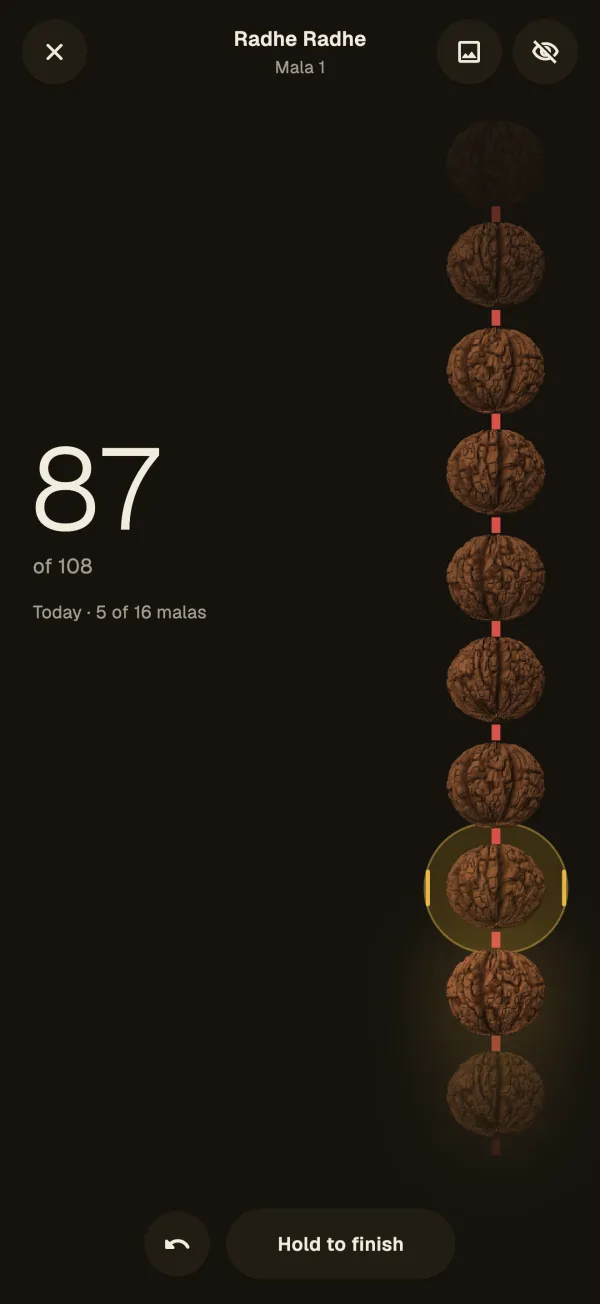
You planned to finish before breakfast. Then the morning ran late, and now you are looking at the whole day's practice with ten minutes before leaving home.
A divided schedule can make a personal daily target easier to keep. It helps to decide where the sittings fit before the day fills up, and to write down what you finish.
Can you split japa across the day?
For a personal routine, you can plan several sittings and add them to one daily record. Swami Sivananda's general guidance describes practice at different times of day. A formal commitment may also specify a minimum for one sitting, a time or other conditions, so follow the instructions you received.
ISKCON's published initiation vows specify a minimum of sixteen daily rounds of the Hare Krishna mantra. That is a particular commitment, not a daily requirement for everyone who chants. If you have taken it, ask your teacher how to arrange your sittings within that commitment.
A schedule for 16 rounds
Sixteen rounds on a 108-bead mala are 1,728 repetitions. The example below assumes a measured pace of six minutes per round. Your pace may be different, so time a comfortable round before reserving the hours.
| Sitting | Rounds | Time at six minutes per round |
|---|---|---|
| Before work | 8 | 48 minutes |
| Midday break | 4 | 24 minutes |
| Evening | 4 | 24 minutes |
| Total | 16 | 96 minutes |
You do not need to use three sittings. Ten rounds in the morning and six in the evening may fit your day better. Keep a little room between chanting and your next appointment so the final round does not become a race.
What if your target is smaller?
The same approach works for a personal target of two, five or eleven malas. These are planning examples, not prescribed counts.
| Daily target | Morning | Later in the day | Evening |
|---|---|---|---|
| 2 malas | 1 | None | 1 |
| 5 malas | 2 | 1 | 2 |
| 11 malas | 3 | 3 | 5 |
If you only have one reliable quiet period, protect that sitting first. You can add a second when it fits. How many times to chant discusses choosing a personal count and following one you have been given.
Keep one daily record
After each sitting, record what you completed. A small note can be enough: “Morning: 3. Afternoon: 3. Total: 6.” When you return at night, the remaining five malas are clear.
Keep each sitting's count separate from the running total. Writing “6” in the afternoon without saying whether it means six more or six altogether is an easy way to confuse tomorrow's record.
With a physical mala, use round markers or a paper tally. In Japo, sittings for the same practice contribute to that day's total, so you can review the day without adding the sessions in your head. See history and insights.
What to do between sittings
If possible, pause at the end of a round and record it before putting the mala away. If you have to stop halfway, preserve the bead position or the recorded number. Keeping count without losing focus covers interruptions in more detail.
A quiet break may work better than a busy journey. When travelling as a passenger, choose a form of chanting that suits your surroundings; the commute guide has practical suggestions. Do not operate a counter while driving.
If a sitting does not happen
For a flexible personal target, look at the time genuinely available. Rearrange what you can without speeding through the mantra to make the schedule look complete.
For a prescribed daily practice or formal vow, ask your teacher what a shortfall means. An app can preserve your record and show the remaining count; it cannot change the conditions of that commitment.
Frequently asked questions
Must all 16 rounds be in one sitting?
The cited ISKCON initiation vow specifies a daily minimum. Ask your teacher about sitting arrangements and any additional instructions you follow. The schedules here illustrate how a daily total can be divided; they do not replace those instructions.
How long do 16 rounds take?
Multiply your own comfortable time per round by sixteen. At six minutes per round, allow 96 minutes, plus any breaks. A longer or shorter measured round changes the estimate.
Can mental chanting during chores count towards a formal vow?
Do not assume that every repetition qualifies for every vow. Ask the teacher who gave you the practice whether its rules allow mental chanting, activity or different sitting times.