You sit down to chant and wonder whether a few repetitions are enough. Does it have to be 108? Should you count at all? And if you stop watching the number, how will you know when to finish?
Start with the kind of practice you are doing. A personal sitting, a daily commitment and a formal mantra practice do not necessarily ask for the same count.
Do you have to count naam jap?
Counting is a way to keep a record or fulfil a stated target. It is not the only way a sitting can be organized. In his general guidance, Swami Sivananda includes practising without a mala and using a watch, alongside instructions for counted repetition.
That does not remove a count prescribed for a particular practice. If your teacher gave you a number, keep that instruction. If you are choosing a personal routine, decide whether a count or a period of time helps you stay with it.
Counted or timed: what changes?
| Approach | What you decide first | What the record tells you |
|---|---|---|
| Counted sitting | Repetitions or malas | How many repetitions you counted |
| Timed sitting | A period you can set aside | How long you spent in the sitting |
| Prescribed practice | The conditions you were given | Whether your record matches those conditions |
Ten minutes does not equal a fixed number of malas. Mantra length, pauses and pace all change the total. If you choose a timed sitting, record the time without turning it into an estimated exact count afterwards.
Where 108 and other numbers fit
| Count | What it represents |
|---|---|
| 108 | One complete round on a 108-bead mala |
| 27 or 54 | A quarter or half of 108; also found on smaller malas |
| 1,728 | Sixteen rounds of 108, the daily minimum in ISKCON's published initiation vows |
| 1,25,000 | Sava lakh, a total used in some mantra practices |
| 1,00,00,000 | One crore, which may be chosen as a long-term target |
These numbers have different contexts. Sixteen rounds is a specific commitment in ISKCON; it is not an instruction for everyone using a mala. A large target on someone else's counter does not tell you what your own practice needs.
Read why a mala has 108 beads for the counting unit, or sava lakh jaap for planning that total.
If no one has given you a number
Choose a modest routine you have time to repeat. That might be a short timed sitting or one mala, depending on the practice you follow. Settle into it before deciding to increase.
Try it on an ordinary working day. Could you keep the same pace without making yourself late? Would it still fit when you are tired? Those answers are more useful for planning than a number chosen on your most enthusiastic morning.
If the target makes you rush through the words, review a personal target. For a prescribed one, discuss the difficulty with your teacher rather than quietly changing the conditions.
Estimate time from your own pace
Time one comfortable round, then multiply. If it takes six minutes, five rounds need about thirty minutes and eleven need about sixty-six. Allow extra time for pauses.
Keep that pace specific to the mantra you measured. A short name and a longer verse do not take the same time. The sankalpa calculator can estimate a daily plan from your target and seconds per repetition.
Let the record hold the number
If you choose to count, you do not need to keep repeating the total in your head. Use the mala for repetitions and a separate marker for rounds. This counting guide explains a few simple arrangements.
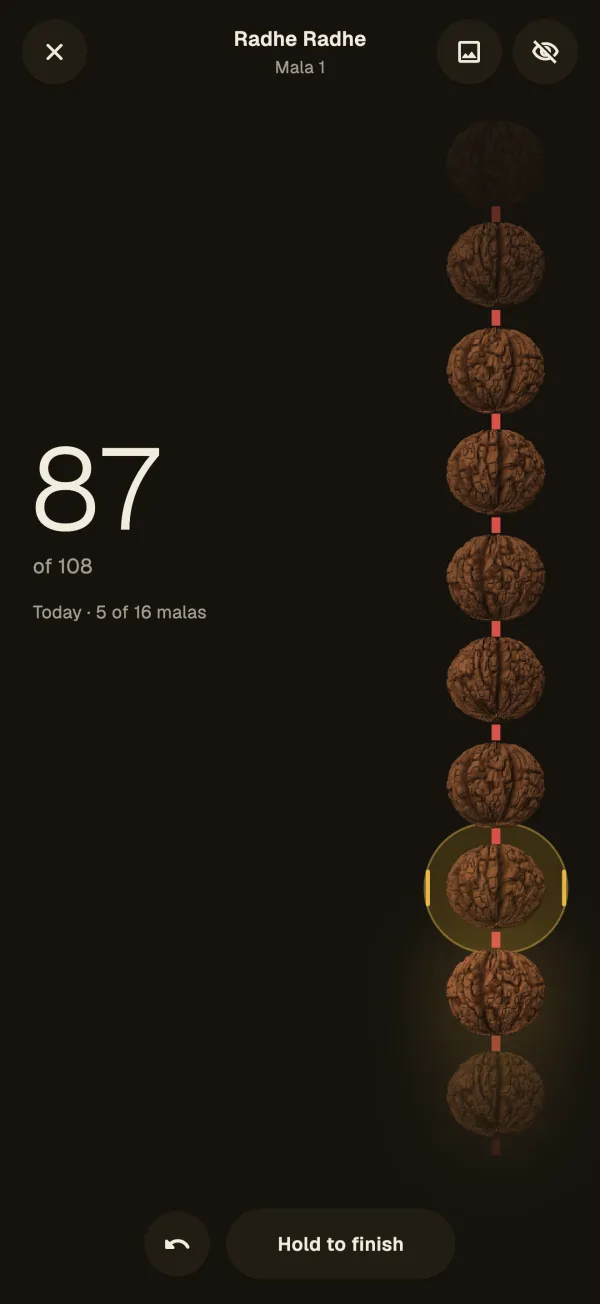
Japo records counted sittings and their history. That can help with a daily total or a longer goal. It does not tell you how much chanting is spiritually enough; the number remains a practical record of what you entered.
Frequently asked questions
Must every sitting reach 108 repetitions?
A round of a 108-bead mala has 108 counting beads, but that alone does not set a universal minimum for every sitting. Follow any count prescribed for your practice.
Can I chant without keeping a number?
For a personal practice, timed or uncounted repetition may be an option; Sivananda's general guidance includes a timed approach. A practice with a prescribed count needs to follow its own instructions.
Is more chanting always better than less?
A larger record does not measure attention or establish a spiritual result. Choose a personal routine you can sustain without rushing, and seek guidance about any prescribed count you cannot manage.
Is there a count that guarantees mantra siddhi?
No count on this page establishes or guarantees that result. Guidance about a particular mantra and its formal observances belongs with a qualified teacher in that tradition.