The three names describe how you repeat the mantra. In his teaching on japa, Swami Sivananda distinguishes audible repetition, whispering and mental repetition, and suggests changing the form when attention wanders.
Vaikhari, upamshu and manasika compared
| Form | Meaning | What you do | A practical consideration |
|---|---|---|---|
| Vaikhari (वैखरी) | Audible japa | Recite the mantra aloud | You can hear your own repetition; consider people nearby |
| Upamshu (उपांशु) | Whispered japa | Recite softly, with gentle lip movement | Quieter than spoken japa, but still uses the voice |
| Manasika (मानसिक) | Mental japa | Repeat the mantra inwardly without speaking | No audible repetition; notice when attention leaves the mantra |
Vaikhari japa: repeating aloud
Speak the mantra at a comfortable volume. You do not need to shout. If you are learning a mantra, audible repetition lets you hear how you pronounce it; check pronunciation with a trusted teacher or recording.
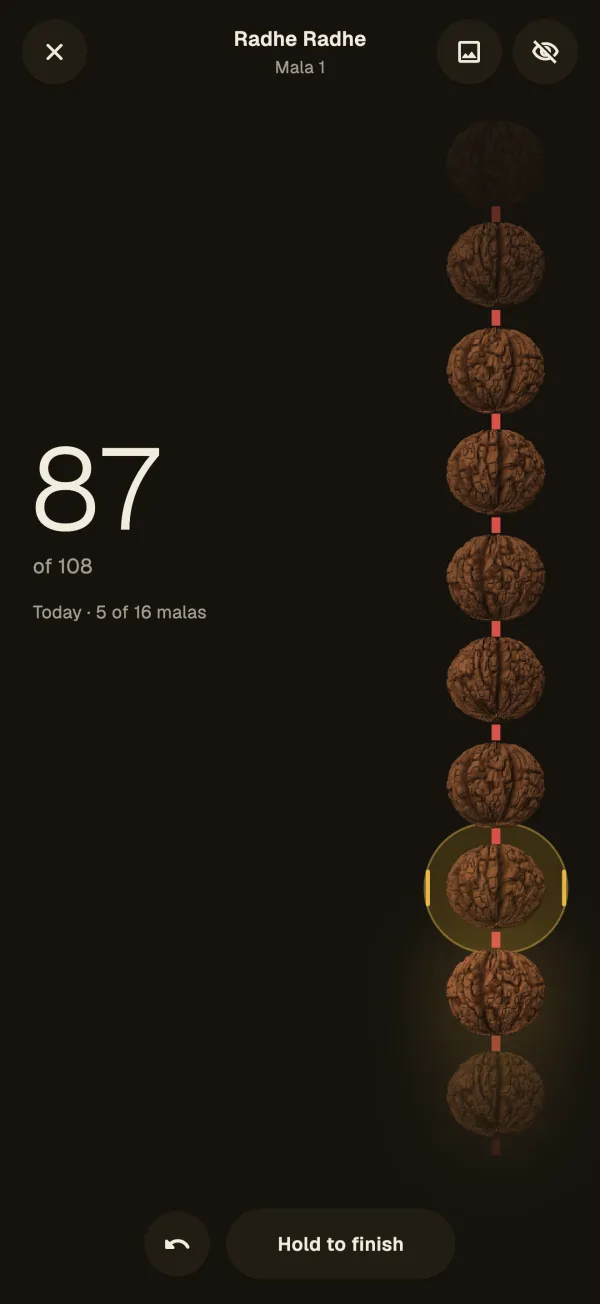
To keep a count, move one bead for each repetition. Our guide to japa with a mala explains the basic method.
Upamshu japa: repeating in a whisper
Lower the voice to a soft whisper. Upamshu is also written as upamsu or upanshu. It still involves speaking, unlike mental japa.
For a shared space, consider whether even a whisper would disturb someone. For travel, see japa on a commute.
Manasika japa: repeating in the mind
Repeat the mantra mentally, with no spoken sound. You may also see the names manasik or manasic japa.
If you lose the thread of the repetition, return to the mantra. Sivananda recommends briefly using audible or whispered repetition when the mind wanders, then returning to mental japa. A mala can help you keep the number of repetitions; it does not establish whether your attention stayed with them.
Which type of japa should you practise?
Follow the instructions of your teacher or tradition for a specific mantra. For a general sitting, choose a form that lets you repeat attentively and suits the people around you. You can try a round aloud, a round whispered and a round mentally, then notice which you can sustain.
Some teachings place special value on mental repetition. That is a spiritual teaching, not a measured effectiveness score. Silent japa is not a reason to rush past a form in which you can stay attentive.
How do likhita japa and ajapa japa differ?
Likhita japa means writing the mantra. It describes a written practice rather than one of the three ways of using the voice. You can explore a digital notebook with the online naam jap counter.
Ajapa japa is commonly used for repetition understood as continuing without deliberate effort, including breath-linked practices in some traditions. Its instructions and meaning depend on the teaching you follow.
Frequently asked questions
What is the difference between upamshu and manasika japa?
Upamshu uses a soft whisper. Manasika is mental repetition without speaking. The difference is the use of the voice, not the number of repetitions.
Can I count silent japa on a mala?
Yes. Move one bead for each mental repetition, following your tradition's counting instructions. A mala tracks repetitions; attention still needs to return to the mantra.
Must I start with loud japa before trying silent japa?
There is no single rule for every tradition or mantra. Follow your teacher's instructions. Sivananda's guidance includes alternating audible, whispered and mental repetition when needed to maintain attention.
Can I chant silently at work or on the bus?
During a quiet break or as a passenger, repeat the mantra mentally. If you want to keep count, try a round with one tap after each repetition.